

Among all the tools you carry on your hunt, HuntCast is the most essential for finding the best time to hunt and planning your time off, sit length, stand choice, and more.
You've scouted hard, put in the pre-season work, and hunting season is finally starting to feel like it's right around the corner. Don’t put all that work and anticipation in jeopardy by hunting when the conditions aren't right.
Here’s how to use HuntCast to understand when you need to stay out of the woods, which is just as important as knowing when to gear up and lock in. Hunting a stand in the wrong conditions can risk burning it out, and the game you're after won't forget. Once animals sense pressure, they'll begin to avoid the area, sometimes for the rest of the season.
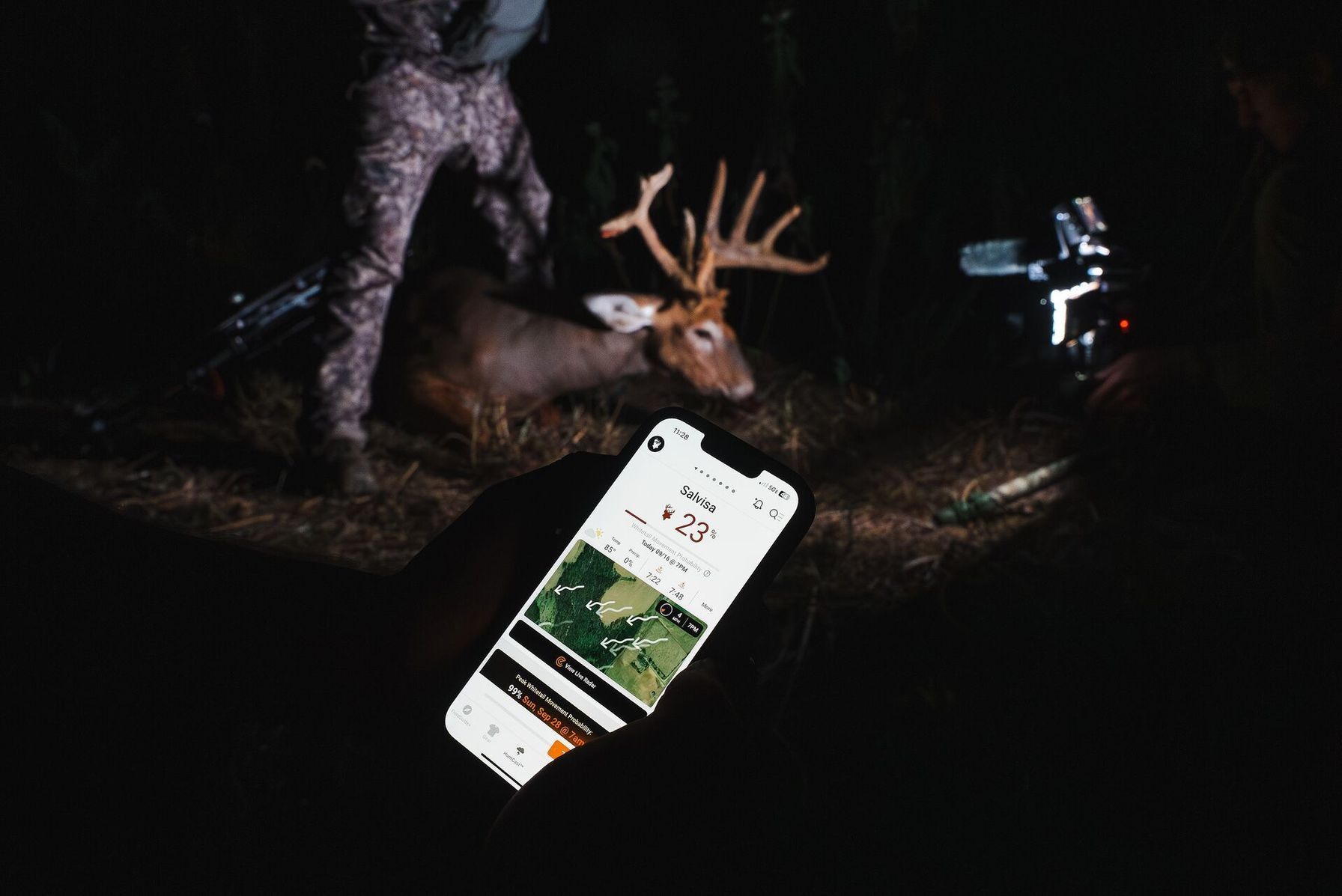
How to Use HuntCast: 6 Easy Steps
Our hunt predictor makes it easy to weigh multiple hunting factors in one place, even when you’re outside of cell service. Follow these steps to start using the app for your next hunt.
- Open HuntWise and navigate to your hunting location. This defaults to your current GPS location, but swiping cycles through the Hunt Areas you’ve created in the maps feature and saved in your My Content folder. Pro tip: Setting up Hunt Areas is a great way for first-time HuntWise users to get familiar with the app.
- Tap the HuntCast icon represented by the cloud and lightning icon in the bottom menu on your screen.
- Confirm your target species in the top-left corner. HuntCast adjusts the model based on favorable conditions for movement that your target game species, such as whitetail deer, mule deer, waterfowl, elk, and turkey, prefer.
- Read your 7-day Hunt Probability score forecast and adjust the timeline slider to see how the game movement probabilities shift as conditions change throughout the day.
- Tap any day to see the in-depth calculation for the prediction based on factors like temperature change from the previous day, wind speed, moon phase, and barometric pressure.
- Set push alerts for days scoring eight or above to get notifications the evening before and ensure you’re not missing out on the best days to be in the field.
How to Use Hunt Probability Score Interpretations
What do HuntCast probability scores mean? Check out this quick overview of what they mean and what to do.
HuntCast Hunt Probability Scores | ||
|---|---|---|
| Score | What It Means | What to Do |
| 9–10 | Peak movement window | Take the day off from work! Sit all day if you can. |
| 7–8 | Strong movement likely | Hunt morning and evening |
| 5–6 | Moderate movement | Hunt high-percentage stands (but don’t burn good spots) |
| 3–4 | Limited movement | Scout, glass, or skip |
| 1–2 | Poor conditions | Use the day for prep, not sitting |
What Is HuntCast?
The HuntCast feature is HuntWise's proprietary hunt predictor. It combines multiple weather and environmental factors to forecast game animal movement by analyzing temperature change, wind speed and direction, moon phase, barometric pressure, and weather fronts, generating a species-specific movement probability score.
HuntCast outputs a percentage-based likelihood that your target species will be moving during daylight hours. These scores are broken down day by day and hour by hour to help you make the most of your time in the field.
These predictions are species-specific, so HuntCast can help you plan a better whitetail hunt, for example. But predictions apply to multiple North American game animals, including turkey, waterfowl, elk, upland game, moose, wild boar, coyotes, and more.
HuntCast also functions as a weather app, displaying current temperature and wind data in a single view. Next to the weather display are daily sunrise and sunset times, so you can calculate the legal shooting times in your region.
Note: Your subscription level determines your forecast window. Standard access lets you see four days out, while Elite members get up to 14-15 days of lookahead data.
HuntCast Alerts notify users in advance when ideal conditions for their target species are forecast, so they can plan their time in the field around peak movement windows.
When to Use HuntCast
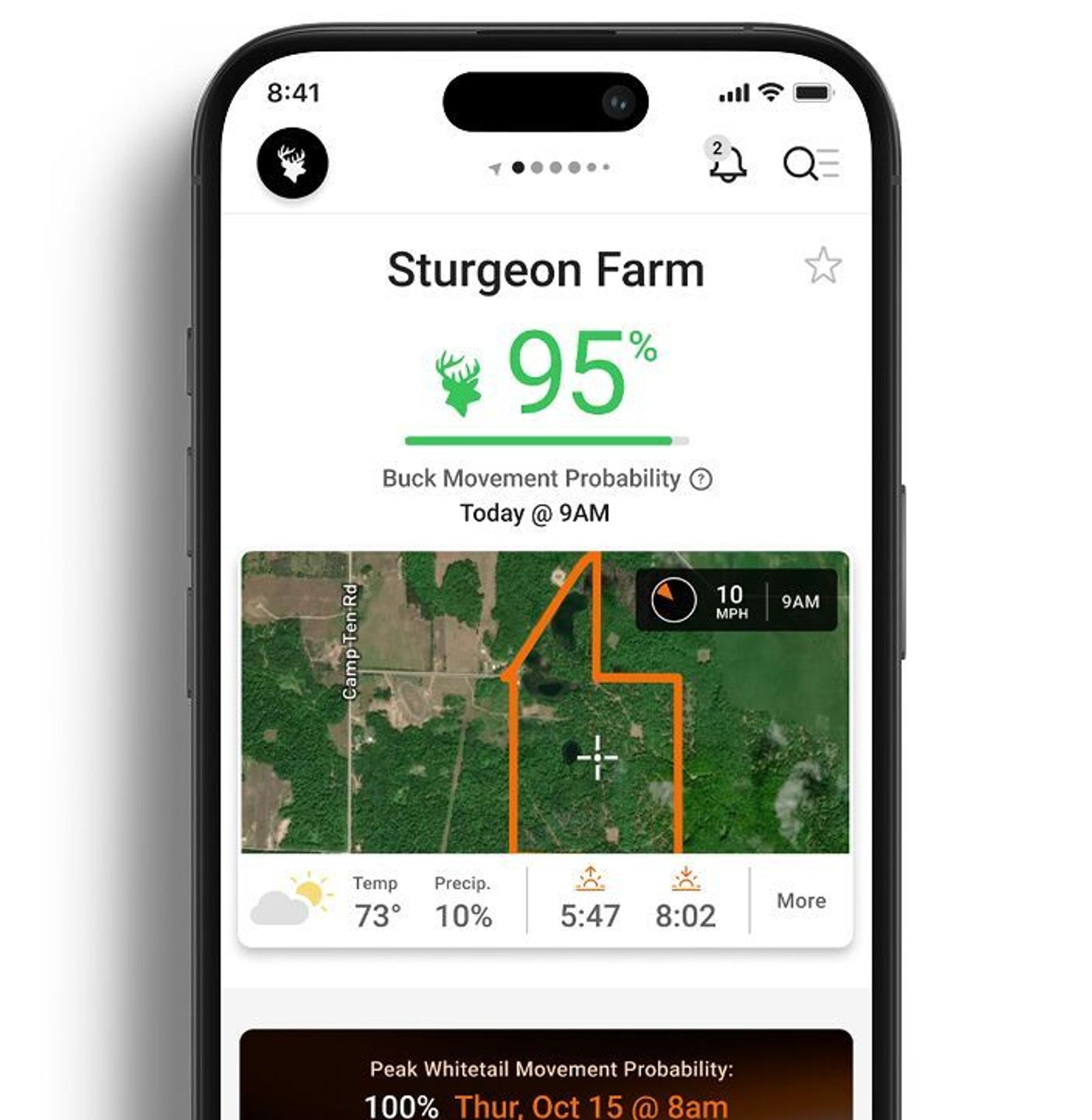
HuntCast is your best tool for predicting behavior daily — over 12 million predictions have been made using this feature to date. So it’s excellent for planning, but it’s also ideal for in-season checks, and every morning you’re out in the field.
Pre-Season Planning and Trip Scheduling
Use HuntCast’s 14-day forecast to identify high-probability hunt days well in advance. This gives you the opportunity to block time off from work or personal obligations well in advance.
Then, compare multiple days side by side to help pick the best two- to three-day window to plan for an upcoming hunt.
Last-Minute Decisions
One of my favorite uses of HuntCast is checking the hour-by-hour predictions right before I plan to hunt to help me decide between multiple locations or properties.
I look at where and when I have the best chance of movement and use that info to determine the best time to enter a location to prevent spooking game.
Rut Timing
Cross-referencing HuntCast with RutCast to align peak movement predictions with rut phases is one of the best strategies in the app. When those two features line up, I start blocking off days on the calendar.
When those conditions stack up just right, it can be an absolutely magical time to be in the woods. Meetings get rescheduled, and work projects get pushed. While I can’t promise you success, that overlap of ideal movement and peak rut activity is about as close to a sure thing as whitetail hunting gets.
How I Used HuntCast for Rut Timing |
| A couple seasons back, I could see that rut activity in my area was peaking alongside prime movement conditions. It was going to be the first sunny day after a cold front in the middle of November with a 99% probability of movement — conditions that every deer hunter dreams of. It may have been the middle of the week, but I wasn’t going to spend that day inside. I played hooky, grabbed my gear, and headed out to still hunt a large tract of river bottom hardwoods. As soon as the sun got up, I saw deer on every trail. Then, the woods exploded with activity. Three good bucks were chasing hard and completely out of their minds. They were locked onto a hot doe they had probably chased for miles as they panted through the woods. At one point, I even had to sidestep behind a large pecan tree just to keep from getting bulldozed over as they charged up the trail I was on. Those bucks had only one thing on their minds, and they either didn’t know or didn’t care that I was even there. It’s one of multiple instances when I’ve used HuntCast and RutCast to make sure I’m always in the woods and hunting at the right time. |
Weather Event Planning
Use HuntCast’s weather function to watch for incoming fronts, which can often trigger increased deer movement patterns as they feed heavily just before and after hunkering down during storms.
When it comes to hunting around the weather, I recommend hunting on either side of a significant weather change for the best chance of seeing game.
Weekday vs. Weekend Decisions
Not everyone has an open schedule, but when you have the flexibility, use HuntCast scores to choose the highest-odds day instead of just defaulting to a weekend. The most successful hunters are in the woods during the best conditions, not just when it's convenient.
Early vs. Late Season Strategy
Movement patterns can shift significantly week to week. This makes HuntCast especially useful when animals are transitioning through seasonal phases, and you need to adapt to those changes.
Learn more about using HuntCast to plan your hunt in the video below!
Use HuntCast to Improve Your Probability of Hunting Success
The right tools can help you decide when the ideal time to hunt is and when it may be better to do some prep work or scout other areas. Hunting, overall, is better when you can plan ahead.
HuntCast makes that easier with Hunt Probability scores that give you the best days and times to be in the field. Your time is valuable, so make the most of it and tag out this season.
Download HuntWise and use HuntCast free during your first week in the app!
Frequently Asked Questions (FAQs)
We’ve got answers to common questions about HuntCast.
Q: How Accurate Is HuntCast?
A: HuntCast accuracy improves with hunter feedback in your area. The model is trained on aggregate movement data plus self-reported successful sits. Most users see 70%+ correlation between high scores and active days.
Q: Does HuntCast work for species other than whitetail?
A: Yes. The model adjusts variable weights by species. For example, moon phase weighs more for whitetail, and wind weighs more for elk. Pressure trend weighs most for turkey.
Q: Is HuntCast free?
A: Basic HuntCast forecasts (today + three days) are on the free tier. HuntCast Pro extends the forecast seven days and adds species-specific variable breakdowns. HuntWise Elite users get 15 days of HuntCast forecasting to plan their hunts.
Q: Can I use HuntCast for properties I don't hunt yet?
A: Yes. Drop a pin on any property and HuntCast generates a score for that location. Dropping pins is useful for planning road trips and out-of-state hunts.


