

Hunting in Florida is not for the faint of heart. From the alligators slicing through the swamplands to the dense and challenging forest environments, Florida is the place for deer hunters who want to test themselves and be rewarded with up to five deer per season to fill the fridge.
While the hot weather can be a turn-off for some, the high population of whitetail deer and generous public land allocations (it has one of the largest wildlife management areas in the country) provide ample opportunities for success.
Understanding hunting seasons, allocations of antler vs. antlerless periods, permits, bag limits, and more is not only important but essential for a successful, ethical, and legal hunt.
If you're ready for an adventure, keep reading for everything you need to know to prepare for a successful 2026–2027 deer season, Florida!

Florida Deer Hunting Zones Explained
Florida deer hunting zones are geographically allocated locations specifically managed by distinct hunting seasons. Different dates are also assigned to the various firearm uses within these zones. Deer season openers typically kick off between August 1 and October 24.
The four zones are:
- Zone A: Covers South Florida and includes DMUs A1, A2, and A3. Its northern edge follows the Charlotte/Lee county line and the Peace River to State Road 70, then runs east along SR 70 toward Lake Okeechobee. Zone C lies directly north of it. Taking deer in the Florida Keys is prohibited.
- Zone B: The smallest of the four zones and consists of a single deer management unit, DMU B1. It covers much of the Green Swamp region in central Florida. Interstate 75 forms its western edge, State Road 50 forms its northern edge, and State Road 60 forms its southern edge. Its eastern edge follows U.S. 441 and the Kissimmee chain of lakes. Zone C borders it.
- Zone C: The largest of the four hunting zones and includes DMUs C1 through C6. It covers most of the central and northern peninsula and the eastern Big Bend. FWC sets zone boundaries along roads and rivers, not county lines, so some counties, including Leon, fall in more than one zone. A zone is a hunting season area, not a wildlife management area (WMA).
- Zone D: Covers the western Panhandle and includes DMUs D1 and D2. North of I-10, it runs from the Alabama line east to roughly U.S. 27. South of I-10, it runs east to State Road 61, U.S. 319, and U.S. 98 at the Wakulla and St. Marks rivers. DMU D1 lies south of I-10, and DMU D2 lies north of I-10. Zone C borders it on the east.
With an understanding of the zones, let's get into the dates for deer hunting in Florida.
Florida Deer Hunting Seasons By Zone for 2026–2027
Dates and regulations are always subject to change, so if you're in doubt about the zoning and regulations, check the Florida Fish and Wildlife Conservation Commission (FWC) website for the latest information.
Antlered Deer
Deer Season Florida 2026–2027 | |
|---|---|
Zone A
| Zone B
|
Zone C
| Zone D
|
Antlerless Deer
Antlerless Deer Season Florida 2026–2027 | |
|---|---|
Zone A
| Zone B
|
Zone C
| Zone D
|
Bag Limits and Legal Hunting Methods
The bag limit for deer in Florida is 2 deer daily, 4 in possession, 5 annually, with no more than 2 antlerless (3 in DMU D2 on lands outside the WMA system).
Make sure the dates you plan to hunt match up with your method of take. Archery season allows only bows. Crossbow season allows crossbows, bows, and airbows. Muzzleloader season adds muzzleloaders. General gun season allows centerfire rifles, shotguns, centerfire handguns, and pre-charged pneumatic air guns, plus everything above.
Note that rimfire firearms, fully automatic firearms, nonexpanding full metal case ammunition, and centerfire semi-automatic rifles with magazines over five rounds are all prohibited.
If you hunt with a bow, broadheads must be at least 7/8 inch wide, and muzzleloaders must be at least .30 caliber.
Antler Rules
Florida’s rules around antlers include:
- DMUs A1, A2, C3, and D1 require 2 points (1 inch or longer) on one antler.
- DMUs A3, B1, C1, C2, C4, C5, C6, and D2 require 3 points on one antler or a main beam of 10 inches or more.
Youth 15 and younger may take one deer per year with an antler at least 5 inches long that doesn’t meet those criteria.
Note that “antlerless” includes no antlers or antlers under 5 inches, and no spotted fawns. Antlerless deer may not be taken in DMU A1.
License and Permits
Visitors and out-of-state hunters must have a Florida hunting license and additional deer hunting permits, such as an entry permit for a wildlife management area (WMA).
- Residents need a $17.00 hunting license and a $5.00 deer permit.
- Nonresidents need the $151.50 annual license and the $5.00 deer permit.
- Archery, crossbow, and muzzleloading permits cost $5.00 each.
- The Management Area Permit costs $26.50. Residents can bundle with the Sportsman’s License ($80.50) or Gold Sportsman’s License ($100.00).
Please also note that hunters born on or after June 1, 1975, and 16 years old must pass a hunter safety course before purchasing a license.
Scouting and Preparation
Due to the diverse natural environment and more than six million acres of wildlife management areas, you'll need to be clever and leverage technology to locate elite hunting locations in Florida.
While deer can be found throughout the state, understanding their preference for habitats with young, low-growing vegetation is critical. To show your knowledge and skill in the hunt, look for deer signs in different habitats, like dense forest that borders waterways or agricultural land.
Finding these distinct locations is easier said than done, and hitting that sweet spot between locations that offer food, shelter, and water can be challenging, especially on foot. To kickstart your search, leverage the HuntWise app's mapping feature using the customizable option to set and plot potential paths deer may take to meet these essential needs.
Make Sure You Have the Right Gear and Equipment
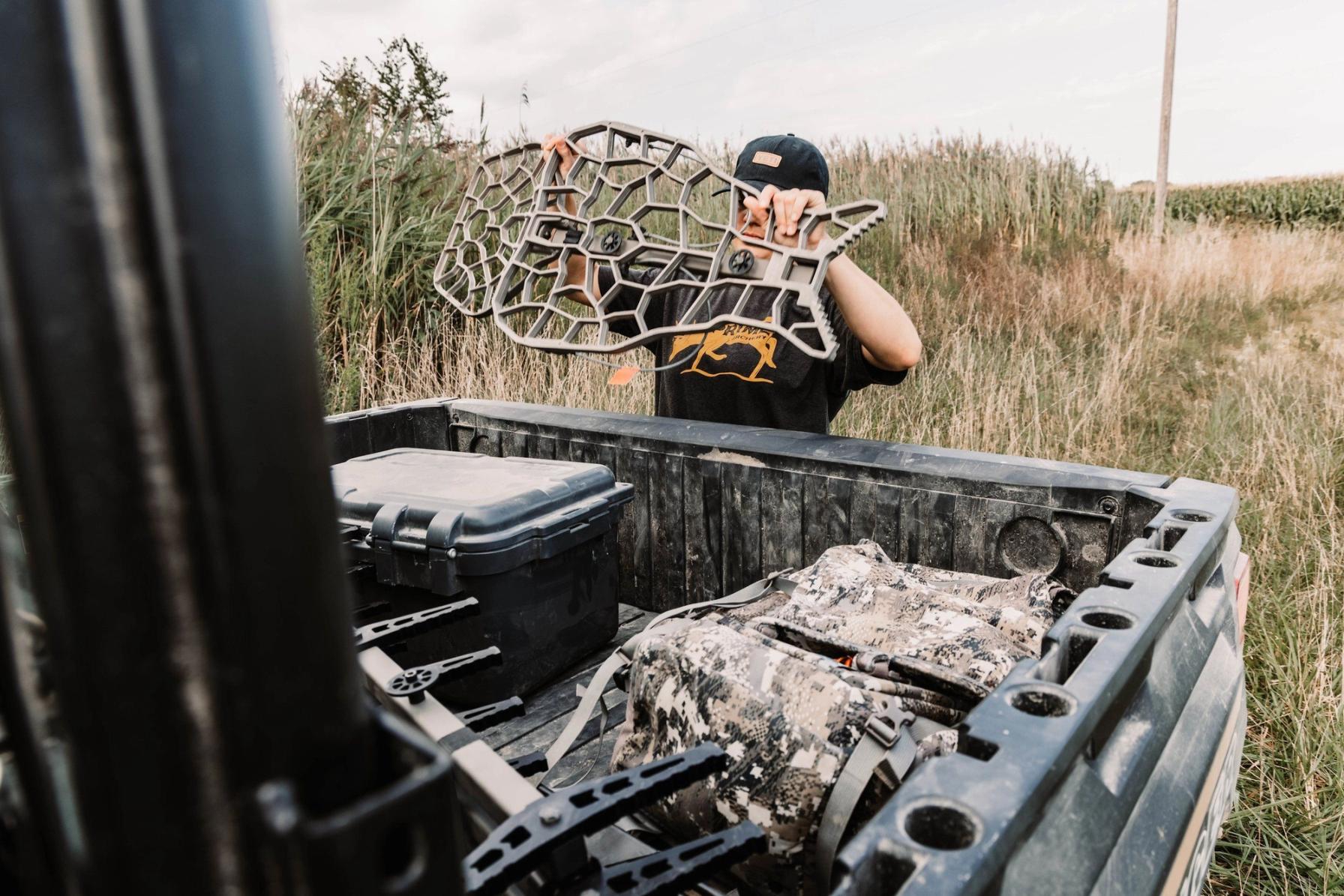
When preparing for a Florida hunt, always consider the climate. Cool, breathable fabrics are essential, as are quality waterproof boots, especially if you're hunting the swampland. Bug spray, sunscreen, and sun protection are all essentials, as is a quality first aid kit and plenty of water and electrolyte-based drinks.
Regarding hunting equipment, essential gear includes:
- Rifle, bow, crossbow, or muzzleloader
- Quality hunting knife
- Camo and blaze orange
- Backpack
For deer-specific gear, including calls, a spotting scope, and more, check out our trusted HuntWise partners for special deals on quality equipment.

Use HuntWise to Bring Home a Big Buck During Deer Season, Florida
While they may not be the biggest bucks in the U.S., deer season, Florida's unique environment, hunting challenge, and generous bag limit (which allows hunters to harvest multiple deer) make it a hunting hotspot for many.
With the opportunity to target a vast expanse of land and even get some fishing or additional hunting, Florida makes an excellent spot for hunting trips for locals and out-of-staters alike.
Starting your preparation early is crucial for a successful deer hunting trip in Florida. The HuntWise mapping feature is a valuable tool for planning and exploring the six million acres of land available for hunting. You can also use in-app markers and different map layers to understand the terrain and plot your approach into the area for a successful hunt.
Content most recently reviewed and updated for recency October 21, 2026.
Frequently Asked Questions (FAQs)
Q: When does deer season start in Florida in 2026?
A: Florida’s 2026-27 deer season opens on different dates by zone. Zone A opens first with archery on August 1, 2026. Zone C archery opens September 19, Zone B archery opens October 17, and Zone D archery opens October 24. The last season closes February 28, 2027, with Zone D’s muzzleloader season.
Q: When is general gun season in Florida for 2026-27?
A: General gun season for antlered deer runs on different dates in each zone. In Zone A, it runs September 19 – October 18, 2026, and November 21, 2026 – January 3, 2027. In Zone B, it runs December 5, 2026 – February 21, 2027. In Zone C, it runs November 7, 2026 – January 24, 2027. In Zone D, it runs November 26 – 29, 2026, and December 12, 2026 – February 21, 2027. These dates cover antlered deer.
Q: How many deer can you take in Florida?
A: You can take up to 5 deer per year in Florida, and no more than 2 of them can be antlerless. The exception is DMU D2, where up to 3 of your 5 deer can be antlerless on lands outside the WMA system. The daily limit is 2 deer, and the possession limit is 4.
Q: What licenses do I need to deer hunt in Florida?
A: Florida residents need a $17.00 hunting license and a $5.00 deer permit. Nonresidents need the $151.50 Nonresident Annual Hunting License and the $5.00 deer permit, because FWC no longer offers the nonresident 10-day license. Add a $5.00 season permit if you hunt during archery, crossbow, or muzzleloading gun season. You also need a $26.50 Management Area Permit to hunt a WMA, and some WMAs require a quota permit in addition.
Q: When is the youth deer hunt weekend in Florida?
A: The youth deer hunt weekend falls on different dates in each zone. Zone A is September 12 – 13, 2026. Zone C is October 31 – November 1, 2026. Zone B is November 28 – 29, 2026. Zone D is December 5 – 6, 2026. The weekend is open to hunters 15 and younger who hunt with a supervising adult age 18 or older.
Q: Do I have to report a deer I harvest in Florida?
A: Yes. Every hunter must log and report a harvested deer, including hunters who are exempt from the license requirement. Log the deer before you move it from where you found it. Then report it within 24 hours, before final processing, before you transfer it to a processor or taxidermist, or before it leaves the state, whichever comes first.
Q: Do I need to wear hunter orange in Florida?
A: It depends on where and how you hunt. On public lands, deer hunters and anyone accompanying them must wear at least 500 square inches of daylight fluorescent orange as an outer garment above the waist. A hat can count toward that total. The requirement does not apply during archery-only seasons or on private lands. Even so, many hunters wear orange on private land during gun seasons for safety.


